Product news: Claude Code 2.1.228 repairs terminal redraw and command-discovery failures
Anthropic
AI Product and Learning Report
500-word summary
Listen to the product news report
Audio summary
Anthropic's Claude Code 2.1.228 release repairs several reliability problems in interactive development. A rare internal layout error could leave a session running while the terminal stopped redrawing. The update also fixes cases where Git or Git Bash was not found on Windows when Claude Code launched from a parent folder of the installation. A further terminal-interface correction prevents a command path from unexpectedly changing session state. These are operational fixes rather than new model capabilities.
The redraw failure illustrates a basic observability problem. What a user sees in a terminal is a view of a process, not the process itself. If the screen freezes while work continues, a student may interrupt a valid operation, start a duplicate, or assume that a requested edit completed. Conversely, an animated interface can look active while no useful progress occurs. Reliable redraw reduces ambiguity, but users still need independent signals such as process state, file changes, exit codes, logs, and test results.
The Windows path fix addresses reproducibility across learning environments. Students often work on managed laptops with different installation paths, shells, permissions, and inherited environment variables. A tool that works only from one launch directory can create false differences in ability and consume instructional time. Courses should publish a small environment check that reports tool versions and repository status without exposing secrets. They should also provide a supported fallback and avoid grading students on undocumented machine-specific setup.
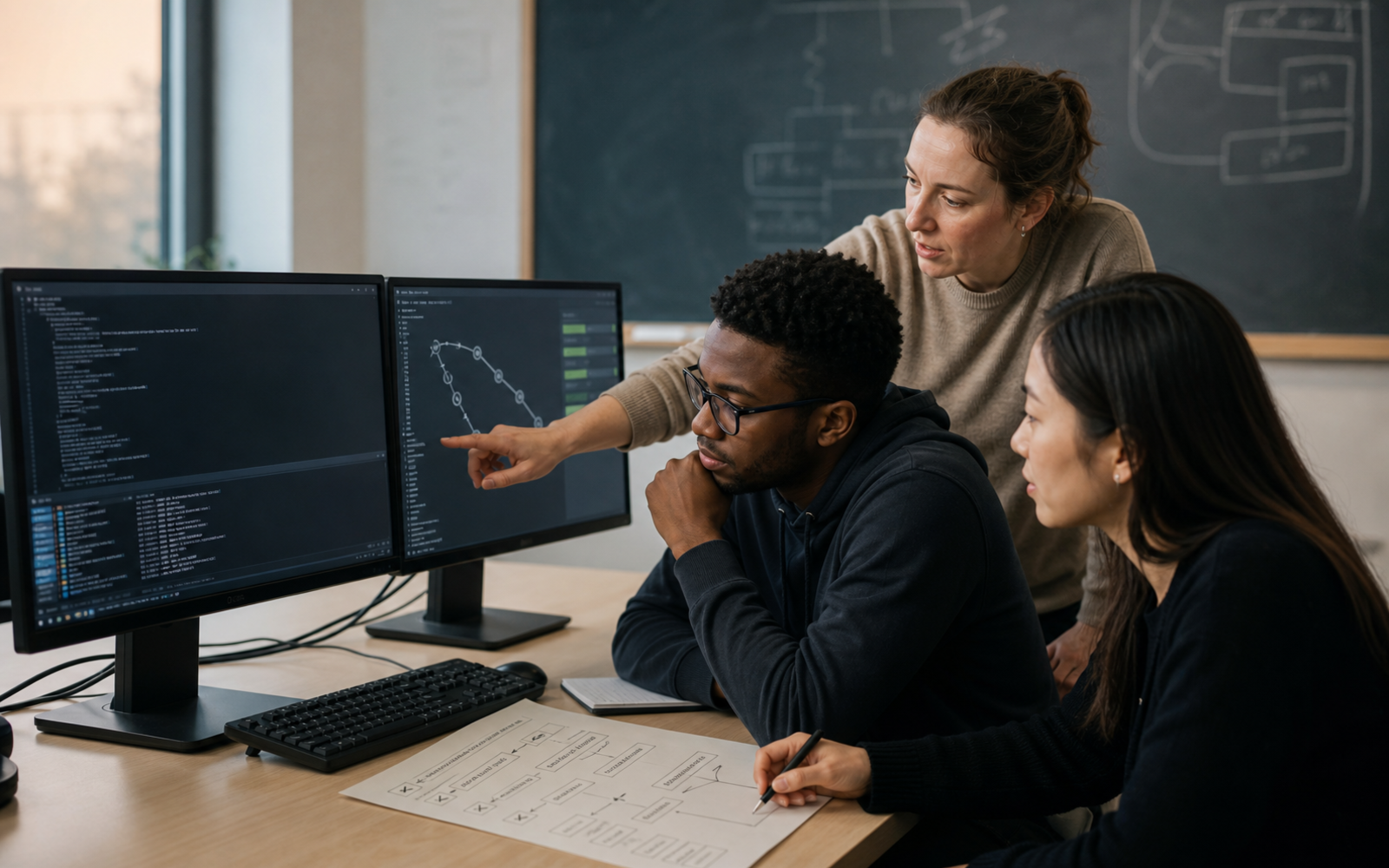
In a classroom coding workflow, the acceptance boundary should be explicit. Before an agent starts, the learner records the intended files and tests. If the interface appears frozen, the learner checks whether the process exists and whether outputs are changing before deciding to stop it. When control returns, the learner examines the exact diff, runs the required tests in a known working directory, and explains the result. A Git command being available only enables the workflow; it does not prove that the correct branch, commit, or remote was used.
These practices also matter in research computing. A stalled display during data transformation can tempt a researcher to rerun a job and overwrite or duplicate outputs. Project-specific temporary directories, idempotent scripts, clear timestamps, and immutable raw data reduce that risk. Teams should distinguish a tool defect from a model error, an environment error, and a failed research assumption because each requires a different response.
For AIEDHK, the product news supports teaching operational literacy alongside prompting. Learners need to understand processes, terminals, paths, repositories, and tests well enough to question what an AI development tool appears to be doing. Claude Code 2.1.228 improves the reliability of that view and removes a Windows setup failure. Trust still comes from a chain of evidence: known environment, bounded task, observed changes, successful checks, and human acceptance. Interface recovery is valuable precisely because it helps users reach that evidence without mistaking the screen for the result. That distinction also helps instructors diagnose support needs fairly.